Thinking linearly in an exponential world
is like taking a sword to a gun fight

Most of us wouldn’t intentionally bring a sword to a gun fight. But, we’re doing that every day when we don’t consciously work to embrace exponential change happening around us.
Unfortunately, most people and most of our organizational systems operate with a linear mindset and struggle to understand exponential change.
Why Exponential Change is Hard to Grasp
Take the classic water lily riddle.
A lily pad doubles in size every day. On the 30th day, it completely covers the pond. When did it cover half the pond? Most people’s immediate reaction is to guess day 15. The real answer? Day 29. On that day, the lily pad covers half the pond. One day later, it doubles again and the entire pond is covered. That’s the trap of exponential growth: for most of the month it took to cover the pond it looked insignificant. Only in the final day did it become obvious it would cover the pond, at which point it was already too late to act.
Pennies
We just aren’t wired to think exponentially. Exponential growth feels so innocuous in it’s early stages. Here’s another example. Let’s say you own a factory that generates $100 million in annual revenue. You’re tired of running it. One night over drinks, you tell me I can buy it if I agree to pay you a single cent today, and double the amount every day for 50 days. Let’s imagine we’ve had a few more drinks than we normally do and I immediately agree. Delighted, I give you one cent before heading home. I can imagine stumbling home smiling at my good fortune.
For the first few days I’d probably keep laughing as I hand over the few cents I owe you. That first one cent grows to 2 cents to 4 to 8 and so on. On day five I’d happily hand over 16 cents. On the eighth day I would need to give you 1 dollar and 28 cents. “Finally, I can give you some paper money instead of coins” I think to myself.
On the 15th day when I’d need to hand over 160 dollars I wouldn’t be smiling anymore. On the 20th day when I hand over $5,243 I might decide it’s time to get in touch with the factory accountant to check on free cash flow. On the 30th day when I would owe you $5.36 million dollars, I’d be trying to figure out how I got such a bad deal as I head to the bank to ask for a short-term loan. I have no idea what I’d be thinking on the 50th day when I’d owe you $5.6 trillion (yes TRILLION) dollars, but I do know our minds all struggle to fully grasp how doubling pennies can grow to trillions of dollars in less than a two months.
More than Moore’s Law
Many people have heard of Moore’s Law. It predicted that the price to performance of computing would double about every 18 months. A floppy disk for an Apple IIc back in the 80s had 140 KB of storage. I remember paying about $3,000 in the 90’s for my first computer (an HP desktop) that had a 1G hard drive. Around the year 2000 it wasn’t uncommon for a desktop hard drive to have somewhere between 6 to 20 GB. My Mac I bought back in 2020 has 1 TB of storage. So over the course of a couple decades, storage went from 140 KB to 1,000,000,000 KB. A great example of exponential growth.
LOAR
What most people don’t realize is technology’s exponential growth applies well beyond storage. Ray Kurzweil’s “Law of Accelerating Returns” (LOAR) describes how the same doubling pattern applies to any technology as it is being digitized. Today, all aspects of our lives are digitizing. Even the bathroom. Digitalization results in an explosion of data. Data drives down costs, speeds development, which opens the door to exponential growth across industries.
It’s Not Just AI
We’ve witnessed the rapid development of AI since ChatGPT broke into the mainstream just two and a half years ago. But robotics, medicine, 3D printing and energy are also seeing explosive growth.
These technologies are all on a similar doubling curve. The difference is how far along the curve each has traveled. For energy, we’re probably in those early days handing over 2 or 4 cents. For AI we’re probably roughly somewhere in the $5M range, and with semiconductors we’re on the other end, in the $5 trillion, $10 trillion side of the curve.
Regardless of which stage of the curve we’re in and which units we use to measure it the same underlying exponential force is at play.
The Linear Thinking Trap
Our brains, our conversations, our organizations, our communities, our politics and our international relations are completely embedded in linear thinking.
We assume the future will look like a slightly altered version of the past. We build annual strategies, allocate budgets, and structure teams based on 12- or 18-month-old data.
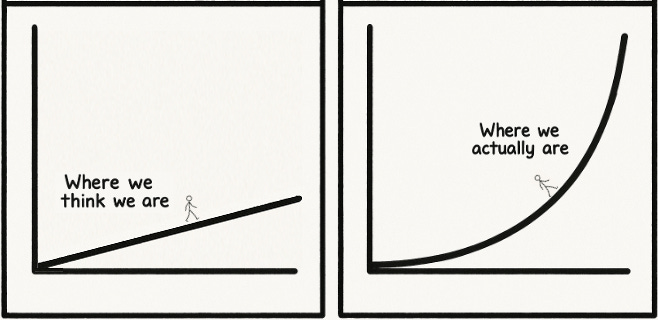
That works in a stable environment, but not during exponential change.
When our systems, organizational, governmental, and political, are optimized for repetition and predictability, they excel at economies of scale and standardization. They struggle to deal with today’s rapid and non-linear change. Companies keep executing on fixed strategies. Governments regulate based on yesterday’s assumptions. Foreign policy is built on historical trends, not exponential forecasts.
We’re often surprised not because things changed quickly, but because we didn’t think they would. (The only thing surprising about any news of China’s tech advances surpassing previous expert forecasts…is that people are surprised.)
The Physical World
Of course amidst all this change, there are still constants. The physical world and natural laws remain as they were.
But how we experience the physical world has changed. We no longer invest the mental effort to remember things. Now we externalize memory to phones and devices. Centuries ago, people stopped relying entirely on memory to store information when tablets and written documents could store information more easily and accurately. Today, I now rely on AI tools to listen to my conversations and automatically summarize takeaways for me. If those tools were to fail, I probably wouldn’t be able to recall more than 10% of a conversation.
The digital world has reshaped even the most human experiences.
“Traditional” Industries
Exponential change doesn’t just apply to the tech industry. Today, every industry is poised for disruption. In fact, I’ve become accustomed to sharing that there is no such thing as a ‘traditional’ industry, there are only traditional mindsets. Any company, no matter how ‘traditional’, can embrace exponential change.
Domino’s is a great example. Food and beverage is a ‘traditional’ industry. Yet, since January 2010, Domino’s stock has outperformed Apple, Amazon and Alphabet.
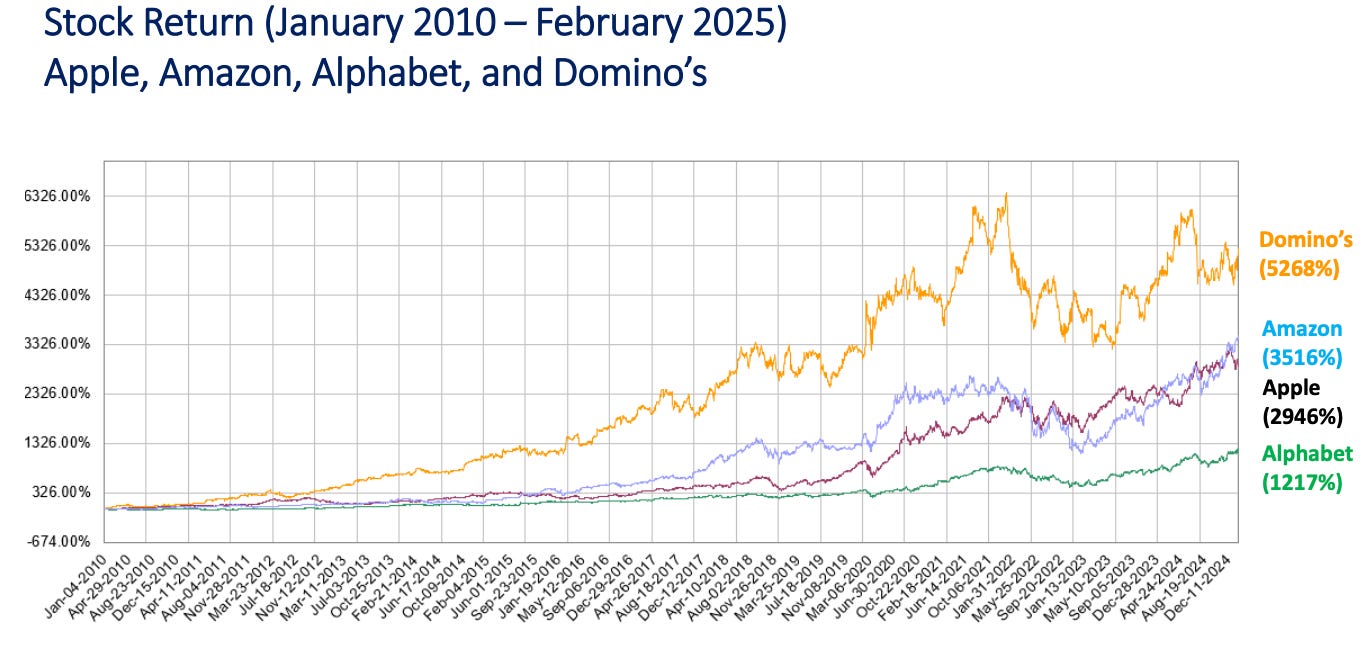
Why? How?
Data.
By digitizing operations and customer touch points, Domino’s unlocked exponential gains in efficiency, delivery speed, and personalization. At the same time, it also made other changes, improving the recipe of its core product. The combined result: a radically improved customer experience and massive shareholder value.
How to Thrive in an Exponential World
Thinking linearly in an exponential world won’t work. We need to make a conscious effort to change our minds, systems and strategies, which involves:
Learning to recognize exponential signals.
Building adaptable systems.
Rethinking our planning models, and
Cultivating a mindset of continuous learning and experimentation.
Exponential change isn’t coming. It’s here now.
What are you’re going to do about it?